

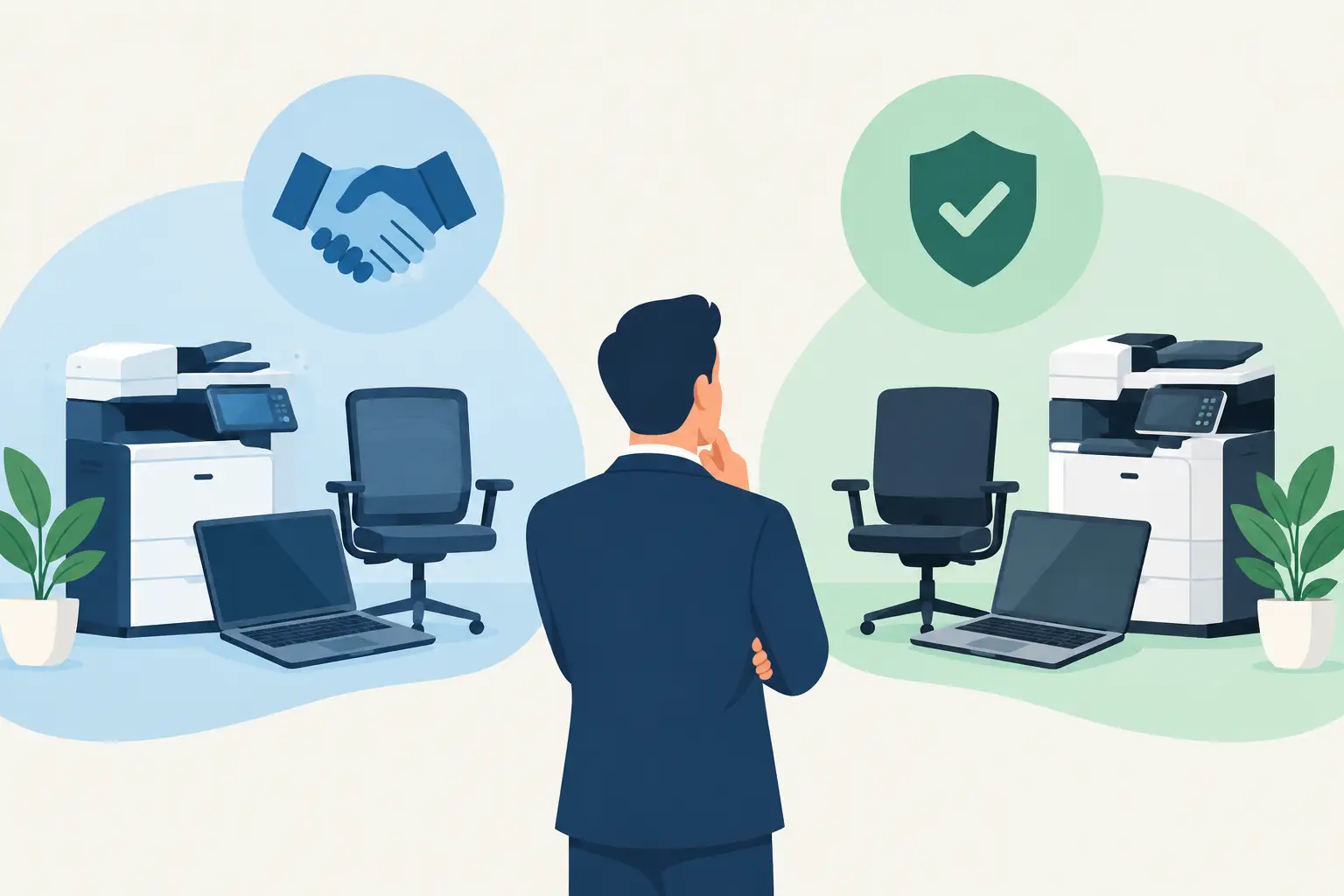
A construction company needs an excavator before a signed project starts. A restaurant needs a new walk-in cooler before inventory is lost. In both cases, leasing versus buying business equipment is not just a question of monthly payment. It affects cash flow, borrowing capacity, tax planning, and how quickly the business can take on its next opportunity.
There is no single right answer for every Georgia business. Buying can build an asset your company owns. Leasing can preserve cash and make it easier to upgrade equipment that changes quickly. The better choice depends on what you are buying, how long you expect to use it, and what your operating cash needs to do over the next several years.
Leasing Versus Buying Business Equipment: The Core Difference
When you buy equipment, you pay cash or use financing to own the asset. If you finance it, your business makes scheduled payments, but ownership transfers to you once the obligation is paid. The equipment appears on your balance sheet, and your company keeps it, sells it, or trades it when the time is right.
With a lease, a leasing company typically owns the equipment while your business pays to use it. At the end of the term, the agreement may allow you to return the equipment, renew the lease, purchase it for a stated amount, or take ownership under a lease structure designed for that result.
That distinction shapes nearly every financial trade-off. Ownership can create long-term value. Use-based financing can protect near-term liquidity.
When Buying Equipment Makes More Sense
Buying is often the stronger move when the equipment will remain productive for a long time and your company expects to use it well after the financing term ends. Think commercial ovens, manufacturing machinery, tractors, service vehicles, dental equipment, or durable construction tools. If the equipment holds value and has years of useful life ahead, ownership can be practical.
A financed purchase lets you spread the cost over time rather than drain your cash reserves in one payment. At the end of the term, you own the asset outright. That can lower your operating costs later because the monthly payment eventually ends while the equipment may still be producing revenue.
Buying can also provide more control. You can modify the equipment, sell it, refinance it, or keep it in service as long as it makes financial sense. For a trucking company that plans to run a vehicle for years, or a contractor purchasing a machine that is used on every job, that flexibility matters.
The downside is that ownership puts the resale and obsolescence risk on your business. If demand changes, maintenance costs rise, or a newer model becomes necessary, you are responsible for the asset. A low monthly payment is not automatically a good deal if the equipment becomes a costly problem before the loan is paid off.
When Leasing Is the Better Business Decision
Leasing can be a smart fit when cash flow is more valuable than ownership. A business opening a second location may need furniture, point-of-sale systems, kitchen equipment, signage, and inventory at the same time. Keeping cash available for payroll, rent, marketing, and inventory can be more important than owning every item from day one.
Leasing is also worth considering for technology and equipment that becomes outdated quickly. Medical practices, logistics companies, offices, and service businesses may need computers, software-connected systems, diagnostic tools, or specialized equipment that must stay current. Returning or upgrading equipment at the end of a lease can be easier than trying to sell aging assets.
Some leases may offer lower upfront costs or more manageable payments than an equipment loan. That does not mean a lease is always cheaper over its full term. It means the structure may better match a business that needs to preserve working capital now.
Read the end-of-term terms closely. A lease can include a purchase option, a fair-market-value buyout, a fixed buyout amount, renewal requirements, mileage or condition standards for vehicles, and return costs. The monthly payment only tells part of the story.
Compare the Total Cost, Not Just the Payment
A business owner comparing a $1,200 monthly lease payment to a $1,350 monthly loan payment may assume the lease is the better deal. That may be true for cash flow, but it does not answer the total-cost question.
Ask what you will pay from start to finish, including the down payment, documentation fees, insurance requirements, maintenance obligations, purchase option, and end-of-term charges. Then ask what the equipment will be worth when the agreement ends. A financed purchase may cost more each month but leave your business with an asset that can be used or sold.
Also consider the revenue the equipment creates. A $90,000 piece of machinery that allows a manufacturer to fulfill larger orders may pay for itself much faster than a $20,000 asset that sits idle. The right financing choice should support productive use, not simply reduce this month’s payment.
Cash Flow and Approval Matter
Many owners prefer buying but choose leasing because they do not want to tie up their available cash. That is a valid business decision. Cash gives a company room to handle slow receivables, seasonal demand, repairs, payroll, and unexpected opportunities.
Your credit profile, time in business, revenue, existing debt, and the equipment itself can all influence available terms. Businesses with strong credit may have access to more options, but companies with challenged credit should not assume equipment financing is out of reach. Some lenders place significant value on the equipment being financed, especially when it has clear resale value.
For Georgia businesses that have been operating for at least one year, Georgia Business Loans can compare equipment financing structures through a network of 75-plus lending partners. That broader lender access can be helpful when a traditional bank says no, requires more collateral, or cannot move fast enough for a time-sensitive purchase. Businesses with credit scores starting at 550 may still have options depending on revenue, equipment type, and the overall file.
Tax Treatment Needs a Real Conversation
Equipment purchases and leases can have different tax implications, but the best approach depends on your business entity, profitability, and current tax strategy. A purchased asset may qualify for depreciation or other deductions. Lease payments may be treated as operating expenses under certain arrangements.
Do not choose a financing structure based on a tax assumption alone. Ask your CPA how the agreement would affect your current and future tax position. A deduction is helpful, but it should not push you into equipment that does not fit your operations or a payment that strains cash flow.
Questions to Answer Before You Choose
Start with the useful life of the equipment. If you expect to use it for seven to 10 years, buying may deserve serious consideration. If you will likely replace it in three years, leasing may offer better flexibility.
Next, look at your cash position. Can you make a down payment without weakening payroll, inventory, or your emergency reserve? Finally, consider your exit plan. Would you rather own an asset with resale value, or return it and move into newer equipment when the term is over?
The most effective equipment decision is the one that lets your company keep operating, keep growing, and keep enough cash available to act when the next job, contract, or expansion opportunity arrives.

